It’s no secret that private capital is flowing into professional sports – and the pace of investment isn’t slowing down. But, why now?
The business of sports is evolving, and so is the playbook for investment. At Sixth Street, we not only see a generational growth opportunity for sports teams driven by advancements in technology and fan engagement, but also an opportunity for Sixth Street to provide our highly flexible solutions to sports teams and businesses.
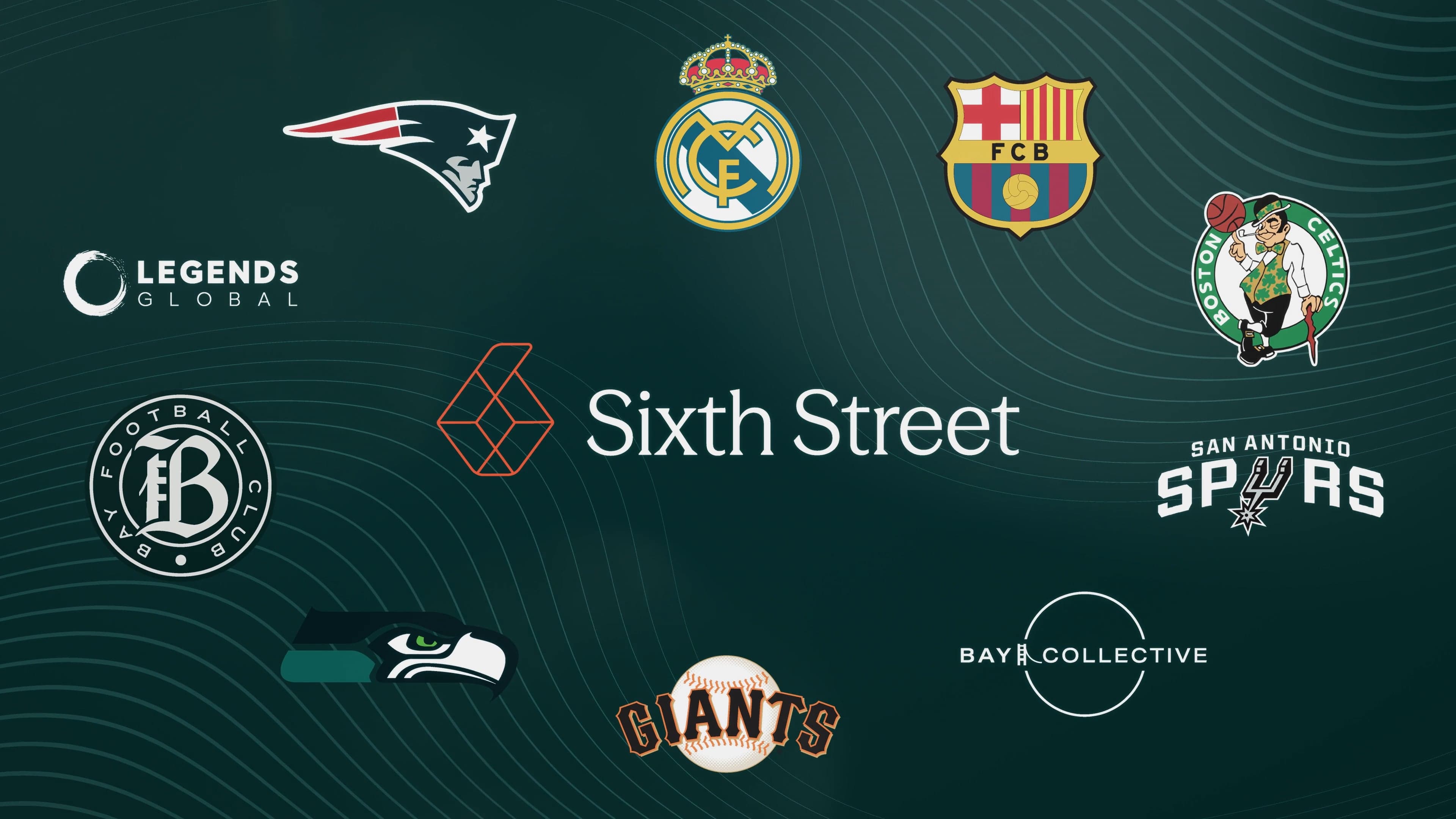
Our Sports, Media and Entertainment team takes a holistic approach to investing in the sports ecosystem – including our investments with some of the world’s premier franchises and leaders in the business of sports including Real Madrid C.F., FC Barcelona, Bay Collective, Bay FC, the Boston Celtics, the Seattle Seahawks, the New England Patriots, the San Antonio Spurs, the San Francisco Giants and Legends Global.
Watch the video below to learn more about the role of private capital in sports and Sixth Street’s approach to the space.
Let’s talk about institutional investing in sports.
Every major U.S. league has slowly opened the door to private investment, and today, 48 teams across the largest American leagues have private capital investments, shown here in blue.
You see, teams already operate a basic cycle: they spend money on players and the fan experience, including venues and entertainment. That investment leads to strong fan engagement, which keeps people coming back and spending more with the team, leading to more revenue that gets reinvested.
With the right capital partner, that cycle becomes supercharged. Teams can increase spending across the board, making fans even more likely to engage. That drives more revenue, more reinvestment and keeps the flywheel in motion.
That cycle is working. This chart shows how much team valuations have grown since 2005 across America's five major men's leagues: the NBA in blue, followed by the NHL, MLB, NFL and MLS. All five have spiked over the last decade, compounding at roughly 10% a year since 2012.
Even just 20 years ago, sports were mostly about your local team and whatever happened to be on TV. Today, they’re global brands operating at unprecedented scale. Running these businesses is no longer a family hobby—it’s a high-stakes, complex operation which is why bringing in private capital is attractive. It’s not just about money though, it’s about execution. And that’s why some of the top franchises have turned to Sixth Street.
One of the most visible areas where execution matters is media rights. Today, sports stand alone as one of the few types of media people still tune in to see live. That makes it among the most valuable content in media as each league brings a rich inventory, with more than 10,000 broadcast hours per year across just the four leagues shown here. Its unmatched volume, paired with steady demand and a fragmented, streaming-driven ecosystem, has helped the value of global sports media rights in this chart to grow more than 80% since 2014.
We see another avenue in stadium development. Across the four major U.S. sports leagues, the average stadium is now more than 20 years old, with many headed toward renovation or full rebuilds. This chart shows that over the past 20 years alone, more than $60 billion has been spent on arena construction. Looking ahead, there’s a backlog of more than $20 billion in new builds on the immediate horizon—with even more focused on mixed-use entertainment districts surrounding stadiums.
In 2020, Sixth Street partnered with Legends —who specialize in stadium planning and fan experience—to focus not just on capital, but on the capabilities needed to deliver these complex renovations the right way, for both teams and fans.
Sixth Street has already committed billions to the sports strategy, partnering with premier institutions across the sports world.
From a strategic partnership with the San Antonio Spurs, to two NFL partnerships with the Seattle Seahawks and the New England Patriots, to venue redevelopment for Real Madrid, to building the first National Women’s Soccer League team in the Bay Area from scratch and more. As the business of sports evolves, so does the playbook—and Sixth Street is helping write what comes next.