
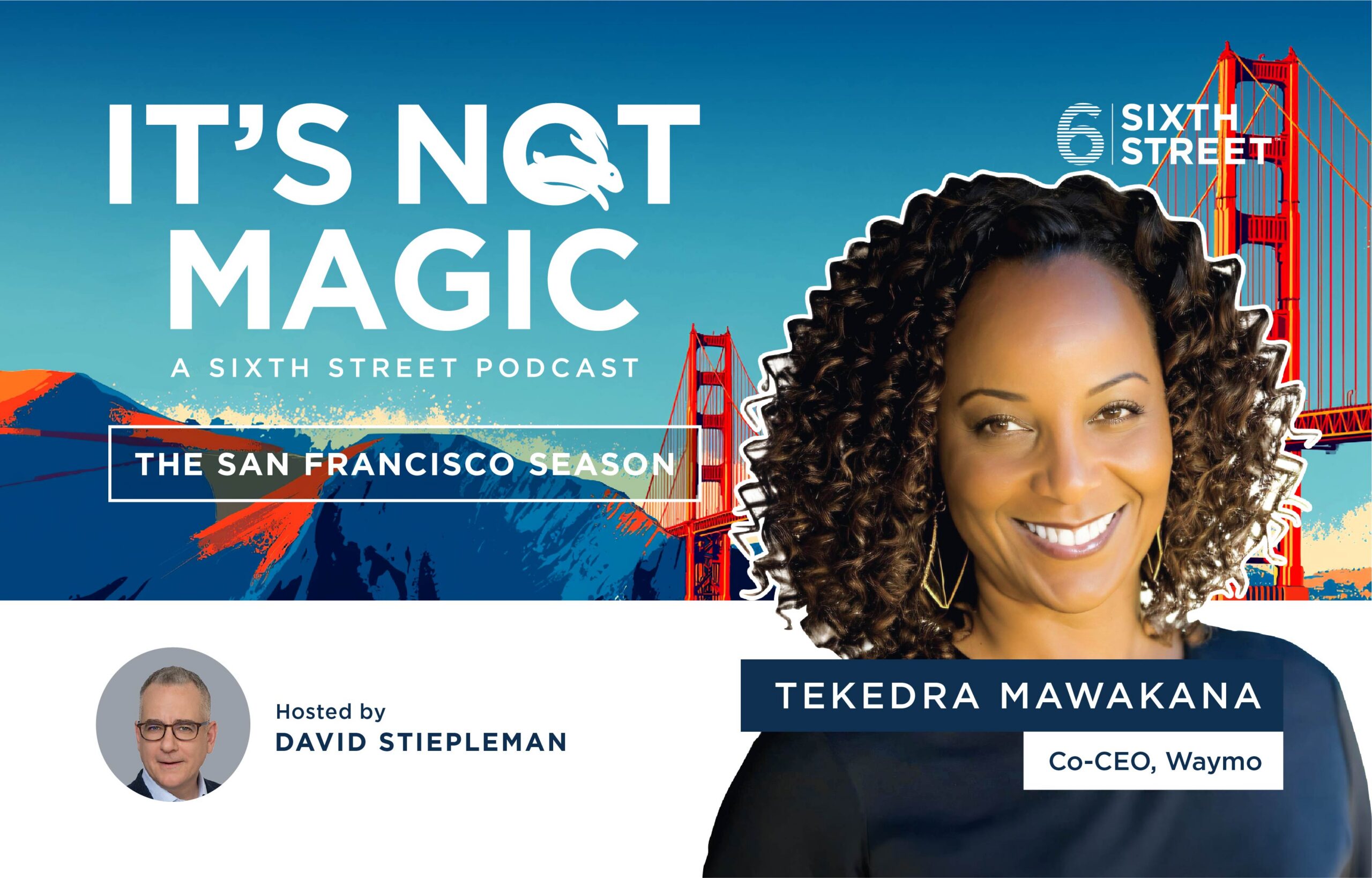
A Conversation with Tekedra Mawakana, Co-CEO of Waymo
In the final episode of It’s Not Magic’s San Francisco season, Tekedra Mawakana, Co-CEO of Waymo, joined Sixth Street Co-President David Stiepleman for a Waymo ride around San Francisco and a conversation at our office about the journey of bringing autonomous driving from an innovative project to a daily reality for hundreds of thousands of riders.
As a leader at the forefront of physical AI, Tekedra shares insights on Waymo’s expansion to operating in ten cities, with many more on the horizon, and the rigorous safety standards that have led to a 10x reduction in injury-causing crashes compared to human drivers. A former IP and telecoms lawyer, she reflects on how her background in navigating highly regulated industries and earning stakeholder trust prepared her to lead a company at the intersection of technology, policy, and global operations.
The conversation dives into the reasoning capabilities of the Waymo Driver, her vision for wider applications of Waymo’s technology, the future of urban space in San Francisco and beyond, and why being “deliberate, strategic, and focused” is the right approach for safety-critical innovation.
Watch the full episode:
Listen On:



More from this episode:
- Waymo: Ready to Ride: Dallas, Houston, San Antonio, and Orlando
- Waymo: Accelerating our global growth: Waymo raises $16 billion investment round
- TIME: TIME Reveals the 2025 TIME100 Most Influential Companies in the World
- The San Francisco Examiner: Tekedra Mawakana is driving San Francisco’s autonomous future
- Automotive News: 2025 Automotive News 100 Leading Women
- Bookshop.org: Mel Robbins’ The Let Them Theory
Episode Transcript:
David Stiepleman: Is it still like a novelty when you get in one of these things? Do you still feel like, I can't believe I’m doing this?
Tekedra Mawakana: It's funny, I don't, in the “oh my gosh, I can't believe it.” I do in the sort of being in awe of the team and all the work I know that they're doing to constantly improve. That's the awe for me.
David Stiepleman: When people talk about Waymo, they say it's getting more aggressive. I've noticed people say that, by the way, approvingly. Is that true?
Tekedra Mawakana: Yeah. I mean, it adapts to the environment. It's learning, it's improving. And the way that we've built the Waymo Driver is all of it is onboard, and so the Waymo Driver is actually making all of those decisions. All the driving decisions. There are sort of four questions it's always asking, which is: where am I? What's around me? What are those things most likely to do? And therefore, what should I do?
David Stiepleman: Has it changed how you drive or no?
Tekedra Mawakana: Completely. I think of myself as having better eyes in the back of my head.
David Stiepleman: So, by the way, I took my parents and they were very excited. They hadn't done this before. My dad sat in the front, my mom sat here. And they loved it. We just went downtown and walked around downtown, and I think we took Waymos back also. It's so great. They loved it. It was really fun. They were like, “this is amazing.”
Tekedra Mawakana: Does that amaze you, that kind of disbelief to full acceptance? You've seen your parents go through it, you've gone through it. We've seen it again and again and again. I find it kind of amazing. And then there are use cases for people who are never alone, ever going from point A to point B because they don't have a driver's license. So it's a family member, it's a driver, it's a bus, whatever it is. This is their first time being alone, going somewhere. So it's true independence. And for me, I think that's one of the most inspiring use cases, having spent time with some of those riders. And they're like, a vision-impaired person or someone with epilepsy: I get to pick up my girlfriend for the date. So there's just this way in which it fulfills needs and opportunities that we hadn't even imagined. I like that. That's really fun.
David Stiepleman: That is fun. I like that.
David Stiepleman: Hi everybody. Hi. Thanks for coming. We just did a Waymo ride. It was amazing. I mean, I've done many before, but not with the co-CEO of Waymo, which is pretty cool. Anyway, welcome to Sixth Street.
Tekedra Mawakana: Thank you.
David Stiepleman: I'm going to introduce you and embarrass you with all your accolades, but I don't think it's embarrassing. Everybody say hi to Tekedra Mawakana, who is the Co-CEO of Waymo. You've heard of it. It's a robotaxi company. A lot of other things too. Waymo started inside of Google. It's widely regarded as the industry leader in autonomous vehicle technology, deploying them safely and at scale in the real world. Tekedra joined Waymo nine years ago, in 2017. You joined as Global Head of Policy. You played a central role in getting the company ready for primetime. You went on to serve as Chief External Officer, Chief Operating Officer, before becoming Co-CEO in 2021. Tekedra is focused on commercialization and scaling the business, building public trust, navigating complex regulatory and market environments. And we'll talk about where they are. But if you live in San Francisco or nine other cities around the United States, you know just how successful it's been so far. Before Waymo, you held senior leadership roles at Yahoo and eBay. You worked at the intersection of technology policy, global operations, and you began your career as a lawyer advising on telecom and IP matters. You're a leading thinker and speaker on leadership, technology, and the future of mobility. If you read any number of major publications, she's been recognized by many of them: Time, Fortune, Forbes, and even Automotive News.
Tekedra Mawakana: Oh, yes.
David Stiepleman: Don't knock it until you read it. Thank you for being here. It's great to have you. So everybody please say hi. By the way, this is the last episode of our San Francisco season, which is very exciting, and I think we're ending on an incredible high note. So again, thanks. The last two years at Waymo—an incredible growth story. Getting it out there, it's kind of reached some new plateau. You just raised $16 billion at like a $120-some-odd billion valuation. Where are you? How's it going? How's it been for the last two years?
Tekedra Mawakana: Great. Well, thank you for having me. As you said, we ended 2025 in five cities, and now we're in 10 cities here in 2026. So we feel really excited about that. As you said, we've raised $16 billion. So we're focused this year on execution, execution, execution. We are laying the groundwork for an additional 20 cities. We're also focused on London and Tokyo as our first two international markets. Really where we are, though, as a company is having moved from: will this technology work? Will riders adopt it? Will it be delightful? Into: how do we scale and make sure that everyone has access to something that's safe, something that's reliable, and something that's magical?
David Stiepleman: Got it.
Tekedra Mawakana: So it is magic.
David Stiepleman: It is magic. Well, we have a problem then with the title, but we'll fix that later. $16 billion is a lot of money. And you brought in some new capital sources. What was that process like? What are you hoping that they bring to the table?
Tekedra Mawakana: Yeah, we have enjoyed all of this time. Like you mentioned, the year that I joined—actually just before I joined, 2016—we spun out of Google. We were the Google self-driving car project and became a standalone company, Waymo, owned by Alphabet. And then starting in 2020, we did our first Series A. So we have, from Series A, B, and C, a cap table of really great investors, Alphabet being the majority one. This year with our Series D, we actually had three new leads come in: Dragoneer, DST, and Sequoia. For us, it was really important to get people who strongly understand that safety is urgent and that there is an opportunity for technology to make the road safer, and who could really get behind the way we're doing it. Because for us, we're doing it grounded in safety. Having technology that can advance something but that can't prove an impact to humans that's tangible and demonstrable doesn't interest us. And so this was really important—making sure we had that synergy. And then last, it's just continuing on this journey. We're not done. And so we needed people who can kind of see the very long vision. Because at Waymo, we've always been focused on building the Waymo Driver, and we want that driver to be generalizable. You and I just had the chance to be in ride-hailing—that's our first application of the technology—but the technology can also be deployed for local delivery, for long-haul trucking, and then eventually licensed to automotive companies for personally owned cars. So we really think of ourselves as: what are the vehicle miles traveled globally, and what percentage of those could the Waymo Driver eventually address? And so huge opportunity, huge runway ahead of us.
David Stiepleman: Yeah. Maybe just hit some of those stats—how many miles driven, how many trips you're doing a week—just given the scale of it. And if you remember them, where you were in 2024, because it's been like that.
Tekedra Mawakana: Yes, that's exactly right. So we're over 400,000 trips per week. If we were having this conversation just last year, we'd be talking about 200,000. It has been significant growth. And we are over 200 million miles now, fully autonomous miles that we've traveled. And we ended last year saying 2025: there were 20 million rides that we've given over the lifetime. Fifteen million of those were given in 2025.
David Stiepleman: Wow.
Tekedra Mawakana: That just gives a sense of where we are and what we've been able to establish. And so, of course, this year is going to be another—you know, we're just growing more than that. Riders are adopting it, they're making it part of their lives. I mean, that's really the validation of all the hard work. Is will people, like your parents, get in a ride and trust it to get them from point A to point B and then make it a habit?
David Stiepleman: Right. My parents did do it over Thanksgiving here. We were talking about that in the car, and they got used to it very quickly. They were very happy with it. Say more about the safety. There are 40,000 road deaths in the United States every year, which is a staggering number.
Tekedra Mawakana: That's right. That's sort of what we think of as the status quo as being unacceptable, especially when you think it's 1.2 million globally. And as you said, 40,000 in the U.S. alone. And so for us, the question in the early days was: how much safer than human benchmarks can this technology be? And when we were at 127 million fully autonomous miles, we were able to establish that we have a 10x reduction in injury-causing-or-worse crashes than a human driving in those same areas. That's really meaningful. And then around pedestrians, we’re 12 times safer than humans. And then the question that often comes up is, well, what happens around the issue of fault? Because as humans, we're used to this issue of who's at fault. And so we did a study with Swiss Re, an insurance company, and they found that our driver was 12 times safer than a human in most instances. So really that safety impact is what we've been trying to have enough data for. We think being transparent about it is really important, but also we just want to make sure that we're measuring ourselves to the right bar.
David Stiepleman: Got it. Why did you start with Jaguars?
Tekedra Mawakana: We actually didn't start with them. Our service actually started with Chrysler Pacifica minivans in Arizona, and we phased those out of the service. Now we have the Jaguars, and then we have the Zeekr vehicles coming online now—you may see those around town—and then we have the Ioniq 5s. We've always had a strategy: we're building the driver, we'll partner with people to build the vehicle. We think there are people who are great at that, and so we have a multi-partnership strategy on that. In those days, we chose the Jaguar because it had the kind of power that we needed in a fully electric vehicle, because all of our vehicles since the Chrysler Pacifica, which was a hybrid, are fully electric.
David Stiepleman: I have a lawyer question for you.
Tekedra Mawakana: Okay.
David Stiepleman: Vehicular laws are written whenever they were written when there's a driver. Are there incredibly inapt rules? You go to a municipality and you're like, this doesn't work. What have you found? Where has it been square peg, round hole?
Tekedra Mawakana: Yeah, it's really interesting. Yes. I mean, it is sort of presumed that there would be a human driver. And so if you think about historically, the federal government regulates the safety of the vehicle—does it meet the standards—and then the states regulate the safety of the driver: licensing, titling, registration. So you have a vision test. And so there are laws that are like, you have to have a vision test. Well, the Waymo Driver can see three football fields and 360 degrees, so I'm certain it could pass it, but it just can't take it. In those early days, what was really interesting is municipalities that were interested in welcoming us, their instinct was to still think about the vehicles in terms of someone behind the wheel. So they automatically started with, okay, the person sitting in the car will have a driver's license. And we're like, no, no, no. We won't actually expand access to mobility if we keep requiring everyone to have a driver's license, right? Everyone who has a driver's license has all of the options available to them. Now let's make sure we can actually have people who can't drive, who can't get a driver's license—either because they're not able, they're not old enough, whatever it is—to be able to do this. So it was those kinds of changes. And it depends—some places still have “you need two hands on the steering wheel.” And so we're trying to change those laws.
David Stiepleman: Interesting. I mean, you still have to have a car at this point. You can't have a car without pedals and without a steering wheel. Is that correct?
Tekedra Mawakana: Not at scale. You can get an exception for a couple of thousand, and it's a framework for automotive companies to be able to test things. So you can do that, but you can't scale to thousands and thousands of cars.
David Stiepleman: Is there any prospect of a national standard on the driving part?
Tekedra Mawakana: We're pushing for it. We think it's pretty important. We think that the Trump administration has an appetite for it. When they were in office the first time, they were super focused on it. And then we didn't have any movement in the interim. And now that they're back, they're back focused on it.
David Stiepleman: I mean, it's kind of a central part of our competitiveness in this field to be able to do that nationally.
Tekedra Mawakana: Absolutely. I mean, this is really important, I think, for the U.S. in new innovative technologies to think about global leadership. I think because we have such a gridlock among the parties, it's easy to get bogged down in this bipartisan fight, but in the meanwhile, other countries will advance, right? And they will advance outside of their borders to other parts of the world. So we just want to be clear that right now, the most mature physical manifestation of AI is the Waymo Driver, and the U.S. should really get behind it and figure out a way to make sure that this becomes the technology that is adopted here and internationally as fast as possible.
David Stiepleman: It's shocking that in a conversation in San Francisco, the first time the word AI came up was just now, but let's talk about AI. We were in the car, right? And we were talking about, whenever you talk about Waymo—well, at least when old people like me talk about Waymo—people say, “oh, it's getting more aggressive.” We were talking about this in the car, and I think people are saying that in an approving kind of way, and you said, yeah, it is true. How does that happen?
Tekedra Mawakana: I think there's two things to think about. How does the driver figure out what it's doing? There are kind of four ways to think about this. First, it's: where am I? Second, it's: what's around me? What are these objects—agents, as we call them—trucks, cars, cyclists, a kid on a tricycle, a puppy? What are these things? What are they most likely to do? So there's all these trajectories that it's calculating at all times. And then based on all of that: what should I do? That's different in all of the different environments, and therefore what the Waymo Driver decides to do differs. It differs in these different environments. I think also, we've been very focused on building safety into our AI—what we refer to as the Waymo Foundation model—from the early days. And so we also want to make sure that we have AI that has a driver that's capable and responsible, but then we have simulation. And simulation is the way we test the driver through various scenarios—billions and billions of miles of simulation. And then we want a critic that evaluates how the driver's doing. The simulation is a closed feedback loop, and then you have this critic that's sort of assessing it. So it's all of those three together actually run on the same AI model. And that's really important, having this whole holistic approach. And that's given us the opportunity to say we have a demonstrable safe impact. So that's been the way that we've thought about it. And so these things that you're seeing in the field—a lot of really smart engineers have dedicated their whole careers, including my co-CEO, to figuring this out.
David Stiepleman: So I was saying I'm from New York. I think New York drivers are the best, New Jersey drivers are the worst. I think Nevada drivers are kind of the equivalent on the West Coast. And the thing that New York drivers do, I think we're aggressive with a purpose. If you're making a left, you get into the intersection, you go. It's more efficient. It's better for everybody. I'm off my soapbox. But I'm seeing Waymo start to do that. And I think what you're saying is like, yeah, they're learning to do it. You're not programming them to do that. They're saying, okay, this is safe and it's better and let's go.
Tekedra Mawakana: It's sort of what's now, to your point of people talking about AI, it's now what people talk about as reasoning. The reasoning capabilities congruent with the environment.
David Stiepleman: Well, the last episode we released was with Daniela Amodei from Anthropic. And you know, you talk about what are we doing with the models, their constitutional AI, all this stuff. And then you release it out into the world and you're not really sure. When you're releasing AI into the world, like it's pretty concrete what it's doing. It's complicated, but it's concrete. Like any lessons for them? As you think about in real life, there's a two-ton thing that's rolling down the street.
Tekedra Mawakana: We really think about how this is physical AI. And so really understanding the environment around it. Not only do you have sand and fog and wind and rain and snow eventually, but also you have humans and all of that is fairly unpredictable. And so making sure that it can respond in that environment. Secondly, we have this safety bar that needs to be very high. Third, we operate real time. We have to make these decisions real time. The AI is working onboard. And then fourth, there's a long tail of what happens on roads. As a human driver, let's say you drive a few hundred thousand miles in your lifetime, like most humans do, you just don't ever encounter what the Waymo Driver encounters every single day because of the number of miles that we're driving. And so what I would, you know, I wouldn't venture to tell any of these folks how to think about their businesses. But when I think about our business, it's really important to understand the environment that your technology is trying to address and make sure it's commiserate with, to me, the value exchange, right? Like we could never say to communities, there is absolutely zero risk that we are exposing the communities to. We've always had like a reasonable risk framework. We have a very sound culture around safety. But then what is that trade off? And I think this is where all of these companies will have to figure that part out, but it's really based on understanding how messy is it for you when you release it into the wild? What are those attributes?
David Stiepleman: Another way to think about that is what you guys do before you launch. You're talking about Tokyo and London? Both driving on the left side of the road, so that's interesting. What do you do before you go to a jurisdiction?
Tekedra Mawakana: Long before, we will start figuring out which organizations
are actually trying to solve the same pain points we are. We have the Waymo community and we want to partner with people who care about access to mobility, who care about safer roads, who care about time back, et cetera.
We also want to make sure we're engaging with law enforcement. We want to train them. We've trained thousands, tens of thousands of law enforcement around the country. First responders on this technology. What do you do when you encounter one and you need it to pull over? That's something that we do. Then from a technology perspective, we show up. We build a three-dimensional map, and so that's like manual driving. We drive around, we build a map. Because we're building our driver to be generalizable over time, that's becoming a smaller and smaller part. So like our cars showed up in Tokyo early last year. Our cars showed up late last year in London, both on the opposite side of the road. So we needed much less time in London. So the point is it should go faster and faster and faster. And then eventually, once we understand exactly what's happening—what did we learn, what did we need to change—then we will get early riders to get feedback into a sort of a limited access fleet. And then we remove any safety drivers and we launch to the public. That's assuming the framework from a regulatory perspective is ready to go, which isn't always the case, but in a lot of cities it is.
David Stiepleman: Tell me if this is fair. There's the old kind of tech, hurry up and break things. They say that's not you.
Tekedra Mawakana: No.
David Stiepleman: Where does that come from?
Tekedra Mawakana: I think it's never really been the ethos of the company. This is safety critical technology. We have to earn the right to be on these roads and then we have to maintain the trust in whatever the social contract is that we entered into when we earned that right to be on the roads.
David Stiepleman: How do you do that?
Tekedra Mawakana: What we say we're going do and what we do needs to match very well. I think when things don't go right, we need to account for that. And sometimes that “didn't go right” isn't necessarily a shared view. It doesn't matter. It doesn't matter. Like we are in the early days of new technology. We have to be willing to be humble. We engage in all levels of government stakeholders and it's a whole flywheel, right? So if you think about it, in the early days, there's a group that's building the technology and the product, and then there are all these teams that are working with external stakeholders. We need what we're doing here and what we're saying here to all work together. And so that culture and that company, I would say those like first three or four years, that was a huge part of what we've been building. And to me, it's one of the things I'm most proud of about the company is because it takes a lot of patience. A lot of audacity to both tackle this challenge and be willing to do it in a way that leads to those kind of safety outcomes. Like 10x reduction in injury causing or worse crashes does not just happen. But also that being a metric that we care about doesn't just happen.
David Stiepleman: It requires, I think, a culture internally. We're very focused on culture. Everybody says they're focused on culture, but we are. You can see the One Team thing up there, super important.
Tekedra Mawakana: I just keep looking at it.
David Stiepleman: But you need a culture of people who feel comfortable saying, slow down. Like, we have to slow down. And how do you make sure that people feel like they have the space to be able to say like, whoa, whoa, whoa. We have to study this. That's hard.
Tekedra Mawakana: It is hard. One of our key values is advance safely. And one of the reasons that's one of our key values is we have to keep moving forward. But the gauge is whether or not we're doing it safely. And so that's part of why we've been transparent about our safety record because we think, one, we think that is part of the contract with the communities in which we drive, but also it's part of like how we think about how we're going to show up. You know, we show up strong or we show up not strong. And so in the early days of Waymo, it's actually something we grappled with a lot, which was: can anyone halt everything or can only certain people halt everything? And in the early days it was like, no, anyone can raise their hand and say, I'm concerned about this, or I'm concerned about that. Now of course we have all the channels, you know, sort of mature as a business. We have safety concern channels, we have all the channels you need for people to flag issues, and that's a built-in and important part of our culture.
David Stiepleman: It's unbelievable. You have the NTSB and other regulators, but also people saying, “they gave us all their data.” Was that a debate inside the company as to whether or not—like that's kind of extraordinary. Nobody does that.
Tekedra Mawakana: Yeah. I mean, I think it's part of figuring out how to introduce this technology into the world. It is also setting a standard of what should be expected. Like you should hand over the data. On the other hand, we have had regulators ask for more data than they can even do anything with. So we've also been trying to work together—not necessarily in this case, but work together with certain regulators, especially at the state level—to say like, we can flood you with data, but it's not necessarily gonna lead to a safety outcome. Tell us what you want and let us help you tell you what we can give you. All of this really just comes down to engaging like as a resource. Like you're here to regulate us, but we also are closest to the technology, and no one's technologies are the same. So let us serve as like a resource that you can grow to trust.
David Stiepleman: Got it. The jobs impact. How do you think about that? I know you said, look, this creates the possibility of lots of new kinds of jobs, and how are you thinking about that maybe specifically, and are you seeing that impact or is that on the come?
Tekedra Mawakana: You know, I think it's important for us to acknowledge and not run away from the fact that there will be an impact on jobs. I also think that it's important for me to look at the jobs that we're creating in every city where we go. You know, we have fleet technicians who are responsible for—you know, there's this question of like, which jobs are going to get totally eliminated? These jobs require humans. We need people to work on these cars and it's fleets of vehicles. We need people to install the charging infrastructure in these cities where we're going to charge these vehicles. We need people to integrate our technology into the underlying base vehicle. And so all of these are areas where we continue to see job creation. I do think, though, that this is a broader conversation that we're going to have to grapple with as a society. And I think one of the ways to engage in that conversation is to be really honest with ourselves about the number of people in future generations who are expressing an interest in going into certain jobs and less than other jobs. And so where might this technology actually help where we were going to have labor shortages? And then also we need to address jobs that will go away. So I just think there's a thoughtful conversation to be had there. I don't think we've gotten there yet, though.
David Stiepleman: Right. It's not just one company.
Tekedra Mawakana: It's not just one company. It's not just one application of technology. It's not just autonomy. You know, there will be a lot of things that cause jobs to go away. And I'd say probably 50% of the jobs at Waymo didn't exist two years ago—definitely didn't exist 10 years ago. And so what are those jobs that when my son is graduating college six years from now, what are the jobs he's going to see that weren't even available to you and I when we graduated law school? I mean, you graduated—who's older? Anyway, when we graduated law school…
David Stiepleman: It was roughly the same time. Let's talk about you, speaking of law school. I love the idea of—you're a lawyer, you're an IP lawyer, you're a telecoms lawyer, business person, world-striding executive. How does that happen? Are there things you just were not prepared for? I mean, speaking of myself, for sure, every single day. How did you approach that journey?
Tekedra Mawakana: It's like eating an elephant one bite at a time. I always thought I would move into business. That's why I went to law school. I didn't know what that meant, but that's what I thought. What's been sort of the thread in my career has been regulated industries have sort of drawn me in. I think it's complex. I think as a policy person, you can actually drive to the bottom line of a business either by making sure that the cost structure doesn't implode under the weight of a regulatory framework, or actually opening a market. And so that was something that drew me there. But then when I got to Waymo, it was very different. It was like everything I'd ever done was this ball of wax. And this was like when I came for the interview, I was kind of like, yeah, this is really interesting because if the technology works—which was something I just had to suspend disbelief around—but I was like, if the technology works and these crazy people aren't that crazy, then—because my mom was just like, you cannot go work at this crazy place with these people who think that people are going to get in these cars without people. But if it works, then everything else is what I've spent my career thinking about. Which is like: how do you drive trust? How do you drive stakeholder alignment? How do you get to the tops of the grass at the base of the grass? We have grass tops and grassroots. What about the political—I don't even just mean policy makers, but just like the political dynamics around big tech backlash, surveillance, all the issues that I had dealt with at different points in my career—really felt like they were encapsulated into this one business. And I thought, you know, it was one of those—I have this blog and it has all these sayings on it, and it was like, “if it doesn't terrify you, it's probably not worth it.” And it was terrifying. So I was like, put me in, coach.
David Stiepleman: Wow. That's brave. That's cool. Somewhere I have a Vanity Fair quote about you. They called you “deliberate, strategic, focused, and cautious.” Is that right?
Tekedra Mawakana: Deliberate, strategic, focused, and cautious. I think that actually is right.
David Stiepleman: The tech CEO, you know, there's no hoodie, no surfboard, nothing. That seems pretty intentional.
Tekedra Mawakana: I think that's right. I think being decisive and humble and being a learner while teaching—and I think all of the things that you just said seem right. Yeah, no move fast, break things, tech bro imitation situation needed. When I first got to the valley, because I lived on the East coast for years when I first moved out here, which was a year before I joined Waymo, it was just like, kind of like…
David Stiepleman: Imposter syndrome?
Tekedra Mawakana: Yes, yes. But I remember thinking like, we don't have to be imposters and we don't have to have a syndrome. Definitely don't have to have a syndrome. We just have to be comfortable that we know a lot because we learn a lot, and the things we don't know, we just haven't learned, and I may not learn most of them. There are really smart people I can hire who will know those things, and so I think it's just been this journey of learning as much as I can and relying on the team to be really smart in the areas that they know well.
David Stiepleman: I love that. We should put that up on the wall too. That's great. It's more words than One Team, but it works. That's really good.
David Stiepleman: We'll put it somewhere.
Tekedra Mawakana: Like a note on the wall. That's fine. I'll take it.
David Stiepleman: Let's talk about cities and San Francisco. Well, first of all, start with San Francisco. I feel like it makes sense that Waymo started here, but why do you think that? Leading question.
Tekedra Mawakana: I mean, this is the city of innovation. But really importantly, it's the place where most of our team lives and works. And I think there isn't anything better than seeing the thing you're building in action, using it every day. You know, we get feedback from the team. It's brutal. There's no one who's more critical of our product than the team that's building it. And so it's a really important place for us. But we didn't start here because the state wasn't ready. And so that was tough. We were so happy to come back and so happy to make it through the CPUC hearing and get our opportunity to launch publicly.
David Stiepleman: Right. Talk about cities more generally. There's a real case for: we don't need parking spots anymore. We don't need parking garages anymore. We can turn things into parks, we can turn things into housing. What's that future? Paint that picture.
Tekedra Mawakana: I think it's really exciting. I don't know if you remember during the pandemic, during shelter in place—maybe it's just my little town—but for some reason they painted parts of streets green, even though it was a street, not a park. Then they put picnic tables on it. Kids were playing, dogs were running. And so I think there will just be these adaptations that we haven't even thought about yet, where people will just take space back and make it more communal. I do think we will need parking garages for cars that are in use. I don't think we will need cars that just sit all day from morning commute to evening commute, taking up 10 floors of parking everywhere. That's not a good use of space. But there will be a need for some amount of parking in every city. But there will definitely be recapture. I think cities will start to think differently about these common spaces. Ideally, what we will see is there will be more of like villages that start to happen again. People will actually commune in the city centers because the city centers are where people are also living and enjoying each other. That to me is very exciting to think about. I feel like, again, I feel like we saw a microcosm of that during the pandemic.
David Stiepleman: Phoenix, where you did start, you're starting to see reduced tailpipe emissions. You're seeing the speed that people are driving is going down. Any other green shoots on that vision of cities?
Tekedra Mawakana: San Francisco and Phoenix are the two most mature markets. So we just haven't seen as much, and they're so different than each other. And certainly we haven't seen any parking structures close or anything that would actually give us a sense. But we have had city council members in different parts of the country reach out to us to say, “we're about to build a parking structure that's going to cost us $50 million. Can we not do it?” So I think their transportation planners are trying to figure out when can we actually take this budget and allocate it elsewhere. It’s exciting.
David Stiepleman: Super Bowl weekend was kind of a big showcase for all of us in the Bay Area, but for Waymo too. Up and down from San Jose, from Mineta Airport to the San Francisco airport.
Tekedra Mawakana: It was just exciting for us to be—you know, we opened the San Jose airport at the end of last year and then we opened the San Francisco airport this year. And so just to have people able to move around freely. Amazing people were able to try out freeways for the first time more than anything. This goes back to this San Francisco season and sitting here in this amazing office with this amazing view—it's like this is a place people come from all over the world and they think of it as a technology epicenter. And so then when people step out and they're able to jump in a Waymo and sort of have this magic carpet ride into the city, it's just a really fun experience. And we got so much feedback from so many riders. They just loved it. We saw it on social—football players, everyone just had the time of their lives. For people who live in other places, it's a sneak peek into the future because it's not real where they live yet. It's real in San Francisco. And so that's nice. And for us it's every day.
David Stiepleman: What are you reading? Are you reading anything good?
Tekedra Mawakana: I just finished reading Let Them. It's a Mel Robbins book on basically letting people be in their own stuff. And while you let them be in their own stuff, you let me. And so like if you say something to me that is offending me because of whatever—not getting into what all of the reasons why you may have done that—let me figure out how I'm gonna sort of manage myself and let you let them be them. I like books that are ultimately about acceptance. I think it is really important to just be in deep acceptance—like whatever the reality is, accept it deeply and then figure out what you're gonna do. So that's what made me pick up that book. It was in the airport. It was a bestseller. I picked it up. You should read it. Do you want to borrow my copy?
David Stiepleman: I'd love to. Do you have it with you?
Tekedra Mawakana: No, I don't have it with me. I'll send it to Sixth Street.
David Stiepleman: Okay. I can probably buy it, but if you send it, I’ll read it.
Tekedra Mawakana: I'll send it in a Waymo.
David Stiepleman: I'll send it back.
Tekedra Mawakana: Thanks. That’ll be amazing.
David Stiepleman: Anyway, Tekedra Mawakana, thank you. Amazing to have you here.
Tekedra Mawakana: Thank you.
David Stiepleman: A great end to our San Francisco season. You were amazing. Thanks for being here.